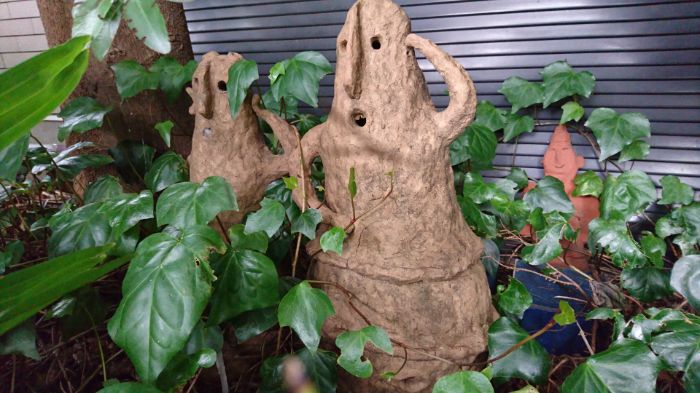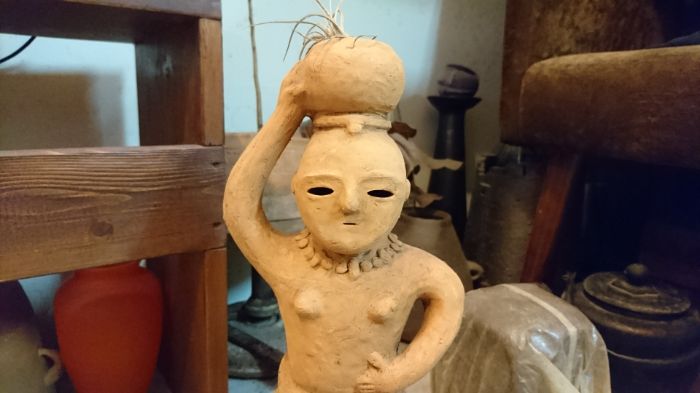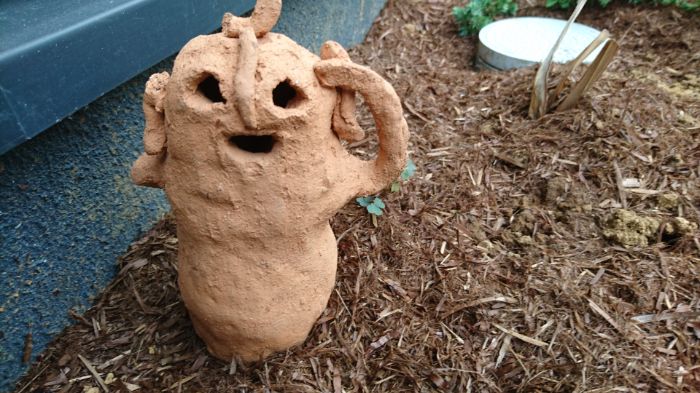
Haniwa or clay images found in residential gardens and an atelier in NISHIOGI.
Haniwa were unglazed clay figures made between the late third and the late sixth centuries and placed straight on or around burial mounds.
The shapes are broadly classified into two types: Cylindrical Haniwa and Figurative Haniwa such as person-shaped, animal-shaped, tool-shaped and house-shaped statues.
What do Haniwa express? There are a variety of theories such that they represent the funeral ritual of the dead or the guardians who prevent the invasion of evil spirits and misfortunes.
The Haniwa with styles of raising a hand are called “Dancing Haniwa” but recent research reveals that they express “Horse Breeders” holding reins and drawing horses: this theory has become to be regarded as influential.
Miyazaki Prefecture is a major production area of Haniwa statues in Japan now.
埴輪(はにわ)
西荻の住宅地の庭先やアトリエで見つけた埴輪。
埴輪は、弥生時代の終わりごろから古墳時代にかけて(紀元3世紀後半~6世紀後半)造られた素焼きの土製品で、古墳の上や周囲に立てて並べられた。
形は大きく分けて円筒形と形象形(人物・動物・器財・家屋など)がある。
埴輪は何を表現したものか?死者の葬送儀礼を表現したものとか、悪霊や災いの侵入を防ぐ役割をもったものなど諸説ある。
これらのうち、片手を上げた形の埴輪は通称「踊る埴輪」と呼ばれるが、近年の研究では、これは踊る姿ではなく、手綱を持ち、馬を引く「馬飼(うまかい)」を表わした像とする説が有力視されている。
現在、日本では宮崎県が埴輪像の一大産地である。